
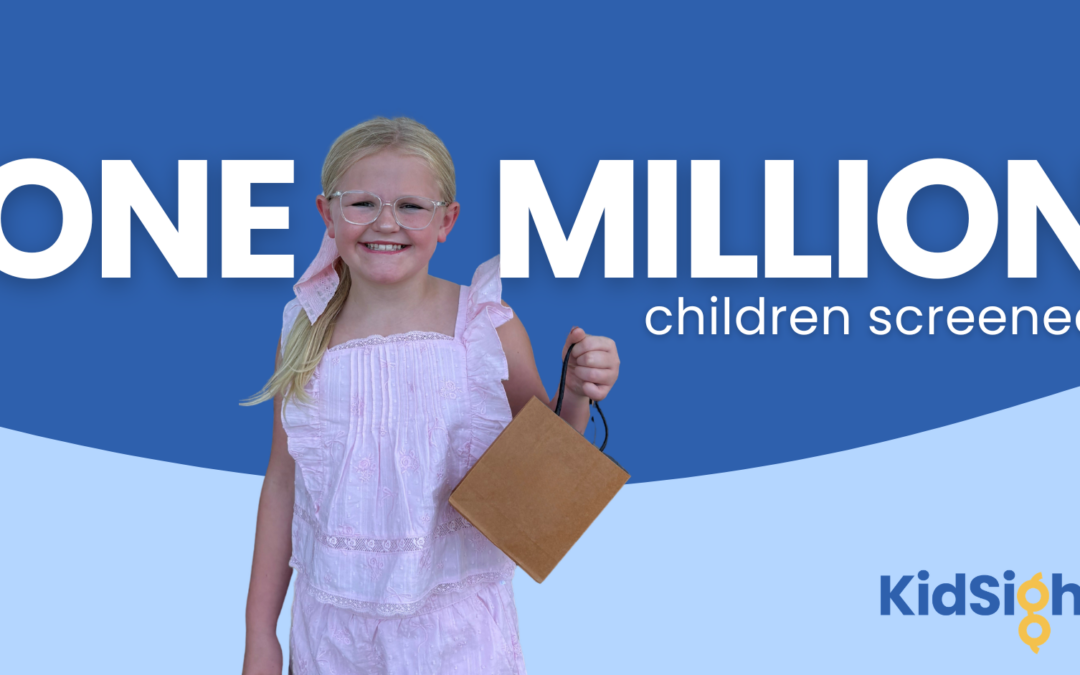
A program that began with a handful of volunteers in St. Louis has now brought vision screenings to more than one million children.
In September 2026, as KidSight staff and volunteers conducted screenings across Missouri, the organization surpassed one million children screened. The milestone represents more than three decades of work to identify vision concerns early and help families take the next step toward care.
KidSight began in St. Louis in 1995 as a small screening effort supported by local Lions volunteers and St. Louis Children’s Hospital. In its early years, a handful of volunteers screened a few hundred children annually. The idea was simple: bring vision screenings to children rather than wait for families to discover a problem on their own.
That local effort grew into a statewide program. Today, KidSight visits schools, childcare centers, Head Start programs, and other places where children learn and play. A screening takes only seconds, but it can identify a potential concern that a child may not know how to describe and that adults may not otherwise notice.
Growth across Missouri
KidSight’s 2025–2026 annual report captures the scale of that growth. During the fiscal year, the organization screened 63,634 children at 871 screening events and served 102 Missouri counties. That was 14,948 more children than the year before.
Of the children screened, 5,949 were referred because their results indicated a possible vision concern. For those families, KidSight’s work continues beyond the screening. Its Care Coordination program helps parents and caregivers understand the results, find an eye care provider, navigate insurance questions, and address barriers that can delay care. Last year, KidSight helped 60% of referred families connect with care.
For some children, access to an eye doctor is itself a barrier. KidSight and its partners held 10 mobile clinic days at six schools during the year, bringing comprehensive care closer to families. Those clinics provided 120 eye exams, and 115 children received glasses.
The children behind the number
 The value of an early screening is often clearest in an individual child’s story. KidSight’s annual report shares the experience of Matilda, who was seven when a screening found that she was at risk for anisometropia – where one eye is weaker than the other. She had not complained about blurry or unequal vision and her family had seen no obvious signs of a problem. An eye exam confirmed the concern, but her parents were grateful to learn there was still time for effective treatment. Now nine, Matilda wears glasses, and her weaker eye has shown significant improvement.
Stories like Matilda’s are why reaching children early matters. A screening does not diagnose a condition, but it can alert a family to a concern and open the door to an exam, treatment, and a clearer view of the world.
“One million children screened means one million opportunities to detect a vision concern early and help a child get the care they need. It represents decades of work and communities across Missouri that have opened their doors to KidSight. I’m proud of how many children we’ve reached and of the lasting impact that can begin with a single screening.”
— Melissa Stephenson, Executive Director
Volunteers have remained central to the program since its beginning. In 2025–26 alone, 100 volunteers donated 5,253 hours and provided 75% of KidSight’s screenings. Their work, alongside KidSight staff, schools, partners, and supporters, has allowed a small St. Louis effort to reach children throughout Missouri. KidSight is a proud Missouri Lions supported organization. From the program’s earliest screenings to its work across the state today, Lions Clubs have helped bring vision screenings to children in their communities.
One million children screened is a moment to recognize how far KidSight has come. It is also a measure of what early detection can make possible: more families with answers, more children connected to care, and more opportunities for children to see clearly as they learn and grow.